
Why "literacy" for Islamic Law?

Islamic legal debate today has moved from the closed circles of specialist scholars, where it remained until the turn of the 20th century, to the open battleground of TikTok, Telegram, and GenAI. This transformation did not happen overnight. 

Find any group of Muslims, glance at any WhatsApp conversation, check a Muslim Reddit forum, and you’ll often find that the most heated discussions, urgent questions, and recurring debates revolve around some component of Islamic law.

  • Marriage and divorce.
  • Parenting and gender dynamics.
  • Prayer and finance.
  • Criminal punishments and slavery. 

These discussions are increasingly marked by appeals to authority: screenshots of classical books, clipped quotations stripped of context, links to fatwa websites, competing scholarly endorsements, and now AI-generated answers presented as authoritative.

How did we get here?

How do we deal with confusion?

Islamic legal debate today has moved from the closed circles of specialist scholars, where it remained until the turn of the 20th century, to the open battleground of TikTok, Telegram, and GenAI. This transformation did not happen overnight. It unfolded over the past century and a half through five revolutions: literacy, print, mass media, the internet and social media, and now AI.

Five Revolutions and Transformed Knowledge

Revolution 1
Manuscripts
Literacy Rates

If you’re reading this, you’re a part of the 87% of the world population that is literate. In the premodern world less than 10% of people could read and write, Muslim societies included. This meant complete dependence and deference to scholarship as religious authority, and a primarily aural rather than textual experience with the Quran. That all changed in the 20th century with the introduction of universal schooling, which transformed the ability to read and write from an elite skill to near-universal expectation.

Revolution 2
Print
Print

The adoption of print in the Muslim world, which expanded significantly in the 18th-19th centuries, transformed access to ideas. It shifted knowledge production from the slow and controlled hand-copied manuscript culture to a swift and mass-circulating medium. This enabled a far wider reading public, facilitated new genres like newspapers and textbooks, and reconfigured who could read, speak, and debate. These changes weakened the scholarly class’s predominant religious and social authority and opened the space for new actors, reformers, journalists, women, and activists to weigh in on religious and social issues.

Revolution 3
Broadcast Media
New Media and Mass Communication

The 20th century did not just bring literacy and print, it ushered in the age of broadcast. Radio, cassette tapes, and satellite television each expanded who could speak and who could listen. Radio preachers in the 1950s and 60s reached audiences far beyond the mosque. The cassette-tape revolution of the 1970s and 80s allowed charismatic preachers and revivalist movements to bypass state institutions, circulating sermons hand-to-hand from Cairo to Jakarta. By the 1990s, satellite TV turned scholars into global personalities, creating popular preachers with audiences in the tens of millions. These media widened the circle of religious debate, enabling more and more voices to engage in religious discourse, and turning once-local discussions into global conversations.

Revolution 4
Internet
The Internet and Social Media

The internet transformed broadcast into participation. Early message boards and blogs, and later social media forums like YouTube, Twitter, TikTok, and Instagram, enabled everyday Muslims not only to access religious content but to produce, challenge, and circulate it instantly. Authority shifted from credentials to charisma and shareability, ushering in a landscape where religious discourse is no longer top-down but open, decentralized, and truly global. Social media, the creator economy, and algorithmic curation constitute a leap of their own—one in which influence is often determined less by depth of scholarship than by engagement metrics and virality.

Revolution 5
AI
The New Horizon of AI

We have recently entered a fifth major revolution: the age of generative artificial intelligence. For the first time, Muslims are not only accessing religious texts directly or through scholars—they are querying them through machines. Many Muslims today turn to AI models to summarize tafsīr, comment on the reliability of a hadith, offer fiqh answers, or synthesize centuries of scholarship in seconds. This radically alters the pathways to accessing knowledge, which completely disembeds it from people and institutions. 
Legal Literacy as a Solution​

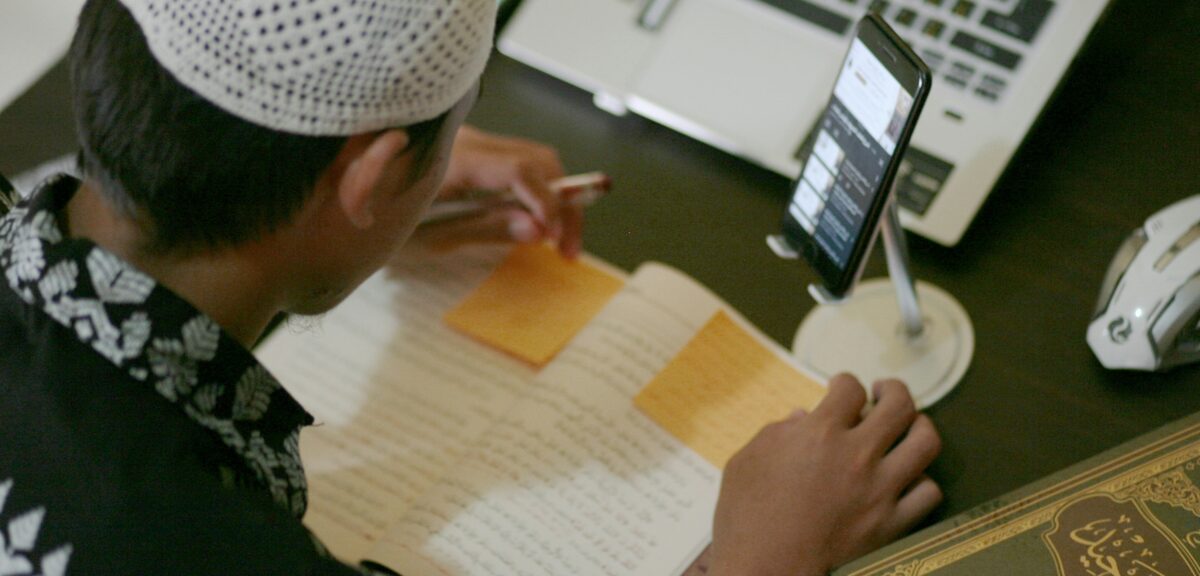
In this hyper-digital age, people are literate, globally aware, and accustomed to participating in public debate. BUT our primary models of Islamic education were built for a world in which 90% of people could not read and only scholars and their students  had access to specialized ideas and texts to offer guidance on how to live a God-centered life. 

The solution is legal literacy. 

Islamic legal literacy is the foundational knowledge, skills, and ethical sensibilities that enable a Muslim to discern reliable legal authority, distinguish the legal from non-legal elements in daily life dilemmas, navigate disagreement responsibly, and practice their religion with integrity.

Just as a grounding in phonics allows readers to decode unfamiliar words and navigate texts independently, legal literacy equips Muslims with the conceptual tools to contextualize rules they encounter, recognize underlying principles, and distinguish sound scholarship from confident ignorance.  

But it’s important to remember, literacy is not a pile of facts, nor a shallow “DIY fiqh” culture. It is a combination of:

  1. Knowledge – the understanding of foundational concepts and principles, familiarity with sources and categories, and a historical awareness and contextual sensitivity 
  2. Skills – the ability to evaluate claims, ask the right questions to the right people, weigh between allowable options, distinguish between authoritative and problematic claims and  authority structures
  3. Disposition / Ethic – the embodied  humility, responsibility, care with religious speech and behavior, and awareness of one’s limitations

Legal literacy serves a new middle category in which the vast majority of Muslims today would fall: not scholars-in-training nor passive followers – historically associated with the idea of lay people or ʿawwam –  but engaged, everyday Muslims who must be literate, empowered, and responsible participants in religious life.

Literacy vs. Specialization

Islamic legal literacy is not about becoming a scholar, it is about:

  • understanding the foundations of Islamic law
  • appreciating its goals, ethics, and reasoning
  • being able to apply this understanding responsibly and thoughtfully in daily life
  • exercising the discernment to identify your limits and to seek out reliable, knowledgeable guidance

Think about medical expertise. Unless you’re a doctor, you are not qualified to perform surgery or prescribe medication. But you still need enough health literacy to choose a qualified doctor, understand a diagnosis, evaluate a treatment plan, know when to seek a second opinion, and maintain your own preventive care. You don’t replace the specialist—you make your engagement with the specialist more effective and safe..

Think, too, about taxes. Unless you are a tax attorney or CPA, you are not qualified to interpret the federal tax code or represent someone before the IRS. That level of expertise requires years of specialized training. But you do need enough tax literacy to file your own return, understand what documents to keep, know when major life changes (e.g.: marriage, self-employment, buying property) alter your obligations, and determine when you need to hire a professional. You don’t become an accountant—you become a competent, responsible participant in a system that still requires experts, but can no longer function if ordinary people remain uninformed.

We already operate this way in every other domain of life:

FieldSpecialist RoleWhat Public Literacy Provides
MedicineDoctors, surgeons, nutritionistsKnowing symptoms, when to consult a doctor, selecting a doctor; reading nutrition labels, evaluating risks; managing our health and well-ness
LawLawyers, judgesKnowing basic rights, when to consult a lawyer, choosing between lawyers; reading contracts, recognizing red flags
FinanceAccountants, advisorsBudgeting, tax literacy, investment basics
TechnologyEngineers, developersUnderstanding privacy, security, digital ethics

But when it comes to religion, we still treat the Muslim public as if literacy is unnecessary and advance uncritical and unengaged deference to authority as sufficient. In reality, for many this model this model became obsolete  over a century ago.

Most Islamic education today—whether in weekend schools, khutbahs, halaqas, or conferences—still assumes a top-down, transmission model: just ask an expert and get the answer. But in a world of searchable fatwas, instant screenshots, and AI-generated rulings, this model does not protect people—it leaves them disoriented and dependent. Nor does it account for all the barriers the average Muslim faces, especially in minority-contexts,  simply trying to access reliable living scholarship.

Conclusion: What a Legally Literate Muslim Community Looks Like

Imagine a community in which every Muslim—regardless of age, background, or profession—interacts with Islamic law with clarity, confidence, and integrity. A community in which our public conversations are marked not by confusion, fear, or competing rulings from algorithmically strong voices, but by grounded understanding, ethical responsibility, and trust in a shared and pluralistic tradition.

Islamic legal literacy makes this possible. It reshapes not only how we make decisions, but how families function, how leaders guide, and how institutions serve. It gives us a new architecture for knowledge—one that honors expertise, empowers the public, and restores coherence to our most urgent debates.

Recognizing the diverse roles Muslims play in communal life, the Islamic Law Literacy Initiative offers four learning tracks that equip each group with the literacy required to serve effectively:

Track 1: Everyday Muslims

With literacy, everyday Muslims become confident participants in their own religious lives. They can distinguish the legal from the cultural, the obligatory from the recommended, the valid from the moral. They recognize when a ruling is misused, when a text is decontextualized, and when a matter requires an expert. They approach disagreement with maturity rather than anxiety, and engage with family, money, and worship, with a sense of calm responsibility and ethical clarity. Equipped with the tools to ask better questions and to discern reliable guidance, they are no longer vulnerable to distorted online voices or superficial “DIY fiqh,” but instead experience Islamic law as a source of clarity and mercy.

For community-serving professionals, literacy transforms practice. Practitioners already sit inside Islamic legal space—whether they intend to or not—when supporting clients navigating marriage conflict, inter-generational struggles, trauma, financial hardship, or ethical dilemmas. With legal training, they can partner more effectively with religious leadership, understand the boundaries of their own role, recognize harm, and identify when a matter requires a fatwa, a legal process, or a therapeutic intervention. Literacy gives them language, categories, and frameworks that protect clients, uphold religious integrity, and enable collaborative, cross-disciplinary care.

For imams, chaplains, and seminary students, legal literacy enhances, without replacing, traditional training. It situates classical fiqh within its historical evolution, clarifies its scope and limits, and strengthens the capacity to navigate contemporary problems that classical texts did not anticipate. Religious leaders trained in this way understand how to identify authoritative sources, how to discern which ruling or practice among a range in our tradition is contextually appropriate, how to engage in cross-disciplinary collaboration, and how to communicate rulings transparently in a digital age where credibility must be demonstrated, not assumed. They can address family, financial, and ethical cases with greater confidence, nuance, and compassion, grounded in both the strengths of the tradition and the realities of modern life.

For lawyers, policy advocates, and those working at the intersection of Islamic and civil law, literacy provides a shared vocabulary and framework that bridges two legal systems. It enables them to develop community processes, institutional protocols, and policy solutions that reflect Islamic values while functioning coherently in American civic life. They can support mosques and community institutions in areas such as religious divorce, mediation, safeguarding, and financial ethics—creating durable structures that address long-standing gaps in family law and communal leadership.

When each group receives the level of literacy appropriate to its role, a new kind of communal ecosystem becomes possible—one in which meaningful exchange, mutual respect, and collaborative problem-solving can flourish. Everyday Muslims understand when to seek help and how to communicate their concerns clearly. Practitioners can identify the legal dimensions of the issues they face and partner intelligently with religious leaders. Scholars and seminarians can draw on practitioners’ insights to develop guidance that reflects lived realities. Lawyers and policy actors can translate these insights into durable institutional solutions.

With this shared foundation, the silos and competing jurisdictions that often fragment our community begin to dissolve. Complex, multidimensional challenges—marriage norms and divorce breakdowns, safeguarding concerns, financial disputes, and institutional policy gaps—no longer fall on one person or one discipline to solve.

This is the promise of Islamic legal literacy: a community in which knowledge becomes a shared language, collaboration becomes our operating culture, and our most pressing challenges can finally be met with the collective wisdom, compassion, and institutional strength they require.

Still have questions?

We’re here to help. Contact us for clarifications, guidance, or more information about our programs, resources, and partnerships.