
Track 1
Everyday Muslims
This suite is the inaugural offering of the Islamic Law Literacy Initiative (ILLI) at Ma’ruf Commons, beginning where Islamic guidance matters most in everyday life: our family relationships.

The course equips learners with tools that can guide private decision-making and for engaging in wider conversations within Muslim communities with clarity and confidence.
Watch PACES course introductory video.
The course equips learners with tools that can guide private decision-making and help them engage in wider conversations within Muslim communities with clarity and confidence.
Course Outline
Introduction
Introduces the course aims, structure, and context, and provides an overview of the framework that outlines how Islamic principles, values, and duties are used as a blueprint for responsibly navigating parent–adult child relationships.
Module 1: Theological Foundations & Core Values of the Parent–Adult Child Relationship
Explores the Qur’anic and Sunnah-based foundations of family relationships, focusing on the core values of birr, iḥsān, and raḥma, and how they shape the spiritual and ethical ethos of parent–child relationships across the lifespan.
Module 2: Parents’ Duties Towards Children
Examines parents’ responsibilities toward their children in both childhood and adulthood, highlighting care, accountability, and ongoing parental duties.
Module 3: Adult Children’s Duties Towards Parents
Clarifies the duties of adult children toward their parents, guided by the values of the relationship, while distinguishing between universal (unconditional) duties and particular (context-dependent) duties.
Module 4: Understanding Obedience: Decision Tree & Case Studies
Unpacks one of the most misunderstood concepts in family life by examining obedience to parents through a decision-tree framework and real-world case studies to support decision-making grounded in Islamic principles.
Module 5: Harm and Maintaining Ties of Kinship
Addresses how Islamic teachings balance the obligation to maintain family ties with the obligation to prevent harm, offering tools to navigate difficult situations with integrity, respectful boundaries, and compassion.
Module 6: Frequently Asked Questions
Addresses common questions and contested issues raised by learners and community conversations, helping situate practical concerns within the course’s broader ethical and legal framework.
Conclusion
Discusses varied avenues for seeking additional support as learners put the course teachings into practice.
Learning Objectives
The learning objectives describe the capacities you will develop by the end of the course. They reflect the course’s emphasis on Islamic principles, shared values, and lived responsibility, and are intended to support both private decision-making and thoughtful participation in wider community conversations.
By the end of the course, learners will be better able to:
- Understand the core Islamic framework governing the parent–adult child relationship.
- Analyze and distinguish between religious obligations, cultural expectations, and personal preferences when assessing claims made in family life or public discourse.
- Evaluate whether claims made in family relationships or public conversations are grounded in Islamic law and ethics, or stem from culture, personality, trauma, or unexamined norms.
- Recognize and respond to harm in family relationships by applying Islamic legal and ethical criteria to distinguish between healthy struggle, harmful dynamics, and exceptional circumstances.
- Cultivate confidence in navigating parent–adult child relationships marked by disagreement, harm, or competing obligations, using Islamic legal principles to hold complexity.
- Develop habits of reflection, consultation, and skillful communication in family life, including principled decision-making, negotiating boundaries with iḥsān, and engaging in just and compassionate relationships.
Course Topics
The course explores topics such as:
- The rights and responsibilities of parents and adult children across life stages.
- How Islamic values like birr, iḥsān, raḥma, and maʿrūf shape family relationships.
- The importance of distinguishing classical ethical-legal terms like birr al-wālidayn, ʿuqūq, ṭāʿah, ṣilat al-raḥim and ḍarar.
- Understanding obedience to parents in adulthood and how to approach difficult decisions.
- Navigating personal choice, expectations, and disagreement.
- Addressing harm while maintaining family ties.
- Engaging common questions and public debates with clarity and nuance.
Available Resources
The course includes the following:
- Six pre-recorded modules.
- A comprehensive workbook designed to support structured learning and application.
- An extensive, in-depth glossary with explanations of Arabic terms, including their origins and usage.
- A Quran and Hadith reference guide.
- A Frequently Asked Questions (FAQ) index
Get PACES Bundle
By enrolling in the online self-paced course, you will automatically receive access to 6 resources in the PACES bundle.
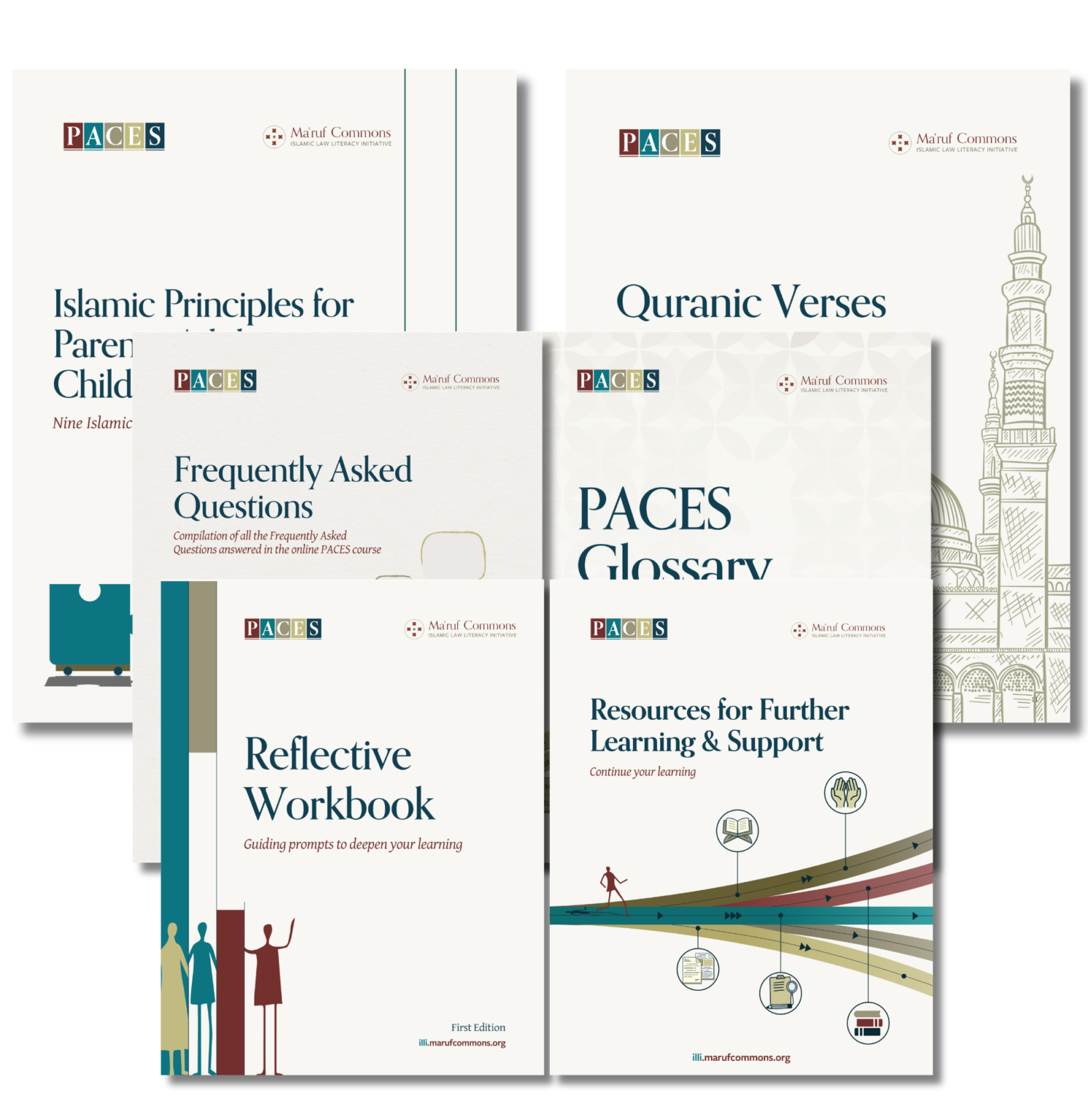
Islamic Principles for Parent-Adult Children Relationships
This framework distills nine Islamically rooted principles that provide a clear roadmap for recognizing what faith-aligned and healthy relationships between parents and adult children look like in practice.
Conceptual Glossary
Rather than offering simple definitions, this glossary aims to situate terms within their broader contexts, because meaning is shaped by how concepts are understood and used. Each entry includes the term’s technical meaning, linguistic roots (where relevant), specialist usage, everyday significance, common misunderstandings, and related terms.
*You must enroll in PACES to access this resource.
A Qur'an and Hadith reference guide.
As you move through the course, you will encounter Quranic verses and hadith reports that illuminate the values, duties, and spiritual dimensions of the parent–adult child relationship. This booklet collects those texts in one place, organized by module, so you can return to them both during and after the course.
*You must enroll in PACES to access this resource.
Reflective Workbook
This workbook is meant to serve as a place for you to pause and reflect on what you are learning, explore what it is bringing up for you—emotionally, mentally, spiritually, or somatically—and to consider what the learning means for you and how you navigate your familial relationships.
You can use this workbook alone or to accompany the self-paced online course.
*You can purchase the reflective workbook by itself or along with the PACES bundle.
Frequently Asked Questions
This resource compiles all the frequently asked questions (FAQs) addressed in the PACES online course and guides you to the module(s) where each FAQ is answered. You can also refer to the Module 6 section in the Reflective Workbook to deepen your engagement with the Islamic principles and questions through a series of reflective prompts designed to help you examine your understanding and practice.
*You must enroll in PACES to access this resource.
Resources for Further Learning & Support
This resource compiles readings, reflective practices, and guidance for seeking professional support as a starting point for further exploration. It is intended for those who wish to expand their understanding of Islamic teachings and principles, deepen their practice, or seek additional support beyond PACES.
*You must enroll in PACES to access this resource.
Fall 2026
PACES Learning Circle
Join a five-month guided learning journey through our Parents–Adult Children Education Suite (PACES).
Sessions are facilitated by scholars, educators, and practitioners to help you build confidence and clarity needed to faithfully navigate parent–adult child relationships.
Enrolling in the PACES Course automatically gives you access to the learning circle.
August 8|September 19|October 24|November 21|December 12
8 am L.A. • 11 am NYC • 4 pm London • 7 pm Dubai • 11 pm Kuala Lumpur


Frequently Asked Questions
What modules are included?
PACES includes just over four hours of content across six modules and is designed to be much more than a simple lecture series. Select videos include case studies so you can practice applying the tools in real time, and each module includes quizzes to reinforce your learning.
You can preview the first video of the course for free on Teachable.
Is this course self-paced? Will there be any live sessions?
All course content is available online 24/7. You can move through the material at whatever pace works best for you. There is no deadline for completion, and learners have lifetime access to the content. There are no live sessions at this time.
Do I need prior Islamic knowledge to take this course?
Whether you are new to Islamic legal concepts or already familiar with them, this course is designed to be accessible and enriching for all levels. We welcome you to come as you are and grow at your own pace.
How much does PACES cost?
The full suite of resources is $175, with flexible payment plan options available: 2 monthly installments of $87.50 or 4 monthly installments of $43.75.
There is also a reflective workbook that can be purchased separately for $25.
Are scholarships available?
Not at this time. PACES is the inaugural course offering of the Islamic Law Literacy Initiative (ILLI), a public education initiative rather than a seminary or degree-granting academic program. As such, traditional academic scholarships do not apply. However, flexible payment plan options are available to make the course as accessible as possible. See our pricing FAQ for details.