
The ILLI Conceptual Glossary
Offers tools for engaging Islamic legal discourse with confidence and precision. It provides clear, contextual understandings of key Islamic legal terms, explores why they matter today, and addresses common misunderstandings.
The terms we use to discuss Islamic law don’t just express concepts; they determine how we relate to them, apply them, and pass them on.
When you confuse shariah with fiqh, you conflate Allah's timeless intent with human interpretation, and suddenly, questioning a scholar's ruling feels like questioning Allah.
When you treat legal validity as moral acceptability, you create loopholes that satisfy the letter of the law while violating its spirit, and feel righteous doing it.
When you collapse honoring parents (birr al-wālidayn) into unquestioning obedience to parents, you create the conditions for parental absolutism and misplaced guilt.
Imprecise language creates confusion and distorts how we understand and practice our religion.
A foundational principle in Islamic legal thought reminds us that judging a matter depends on accurately understanding it (al-ḥukm ʿalā al-shayʾ farʿun ʿan taṣawwurih). Judgment does not come first. Understanding does.
Definitions of terms are a necessary starting point, but they are rarely sufficient on their own. When definitions are detached from context, from related concepts, or from lived application, they risk flattening meaning rather than clarifying it. When definitions are situated carefully—alongside purpose, usage, and common misunderstanding—they become tools for responsible reasoning.
The ILLI Conceptual Glossary offers you the tools to engage Islamic legal discourse confidently and correctly. It provides precise and contextual understandings of Islamic legal terms, why they still matter today, and correctives for common misunderstandings.
What Makes This Glossary Different
Imprecise language creates confusion and distorts how we understand and practice our religion.
A foundational principle in Islamic legal thought reminds us that judging a matter depends on accurately understanding it (al-ḥukm ʿalā al-shayʾ farʿun ʿan taṣawwurih). Judgment does not come first. Understanding does.
Definitions of terms are a necessary starting point, but they are rarely sufficient on their own. When definitions are detached from context, from related concepts, or from lived application, they risk flattening meaning rather than clarifying it. When definitions are situated carefully—alongside purpose, usage, and common misunderstanding—they become tools for responsible reasoning.
The ILLI Conceptual Glossary offers you the tools to engage Islamic legal discourse confidently and correctly. It provides precise and contextual understandings of Islamic legal terms, why they still matter today, and correctives for common misunderstandings.
This is not a dictionary. Dictionaries offer definitions; this glossary offers understanding. You won’t find exhaustive Arabic morphology or every possible meaning a term could carry. Instead, you’ll find what you need to engage meaningfully with Islamic law as it relates to your everyday life and to recognize when terms are being used differently elsewhere.
Terms are highly dependent on context. A word might seem straightforward until it’s used in real-life situations. The context in which a term arose can expand or narrow how it applies. This glossary provides that context. It doesn’t just tell you what a word means; it shows you how it functions, why it matters, and how specialists actually use it in practice.
Many glossary entries are terms of art: words specialists define differently from everyday usage and, in some cases, differently across fields or scholarly traditions.
These terms are shorthand for experts to communicate precise meanings. This glossary bridges that gap, giving you access to specialized definitions while explaining why they matter in daily life.
Muslim scholars have always emphasized that clear definitions are the basis for establishing common ground. When we define terms precisely, we avoid ambiguity and create a foundation for speaking to each other about complex concepts. We also narrow the scope of genuine disagreement so that differences can be discussed productively rather than reactively.
Precision doesn’t mean inflexibility. Despite their attention to detail, Muslim scholars consistently warn: La mushāḥa fil-isṭilāḥ—we do not argue over technicalities or semantics. A difference in expression is not the same as a difference in meaning. The reality of things is fixed, even if the terms used to describe them fluctuate.
You may find that other programs use different terms for similar concepts. That’s expected and acceptable. What matters is engaging with the underlying concepts and examples, understanding the possible range of meanings that specialists have preserved and refined over centuries.
Our approach directly addresses a core challenge we face today: many misunderstandings of Islamic law stem from confused or imprecise terminology. When we conflate terms, oversimplify concepts, or rely on colloquial usage without understanding specialist meanings, we create unnecessary obstacles to faithful practice.
The glossary helps dismantle these misconceptions by establishing a foundation of shared, precise language that will support you in navigating Islamic legal sources with both confidence and humility.
How the ILLI Glossary Is Structured
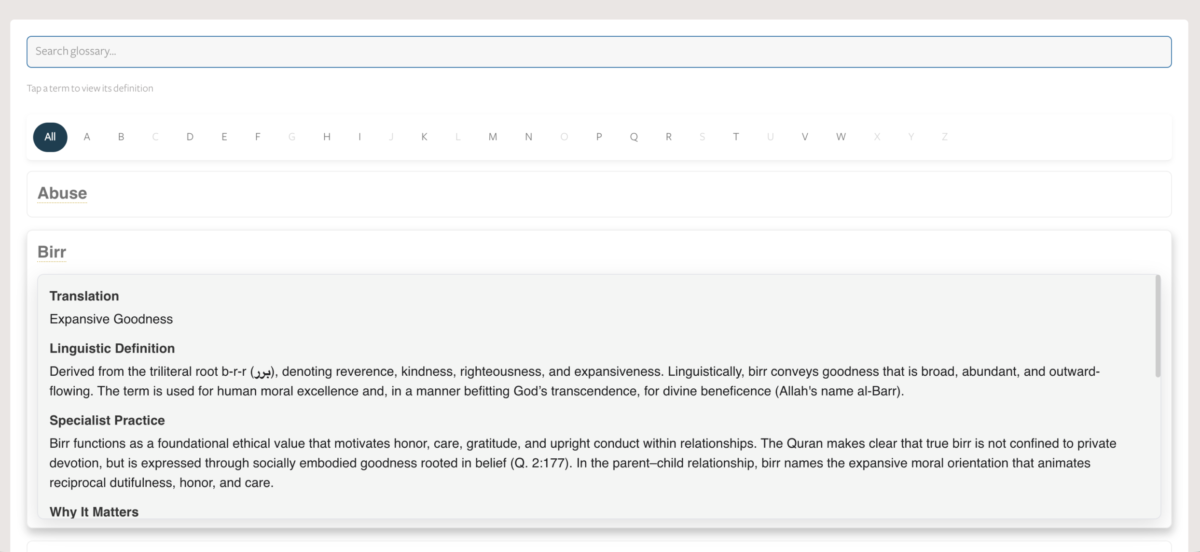
The terms in the glossary are organized so that related concepts appear together. For each entry, you will find:
- A technical definition as used within Islamic legal and scholarly traditions
- A basic translation, if the term is Arabic
- A brief linguistic note, often drawing on the triliteral Arabic root where helpful
- Specialist usage, highlighting how the term functions in legal or other scholarly practice
- Why the term matters today, including how it shapes reasoning and everyday decision-making
- Common misunderstandings, especially where community usage diverges from technical meaning
- Related terms, linking concepts across the glossary to support coherence
The structure and multi-dimensional analysis of each term are designed to help learners move beyond isolated meanings toward relational understanding.
A Companion to Your Learning Journey
The ILLI Glossary is designed as a companion to your journey of increasing Islamic legal literacy. It provides a common set of terms for ILLI, is structured with related concepts appearing together, and each term is tagged with an identification code referencing the learning resource where it first appears. There’s no shortcut to actually learning the principles of Islamic law literacy, but this holistic understanding for key terms can significantly enhance your learning experience.
You can use the glossary to:
- Build foundational understanding by reading through entries on your own
- Reference specific terms as you work through ILLI course materials
- Clarify concepts when you encounter unfamiliar terminology in broader Islamic discourse
- Check your understanding against how specialists traditionally define concepts
- Recognize when terms are being used imprecisely in community conversations
An Invitation
We invite you to engage with these terms with a critical eye and an open heart. We hope that this glossary allows you to encounter new ways of understanding terms you may have heard before and gain a deeper understanding of how experts have traditionally conceptualized these concepts.