What Eid Teaches Us:
Law, Difference, and Devotion
In the language of our spiritual tradition, Eid is not only a day, it is a constant renewal of a state of presence, of witnessing, of nearness to Allah.
By: Dr. Mariam Sheibani
In the Islamic tradition, Eid does not arrive as a single event. It unfolds through a series of subtle transitions, from night to morning, from private to public, from completion to continuation. Each of these transitions has its own texture, its own form of ʿibadah, yet all return us to the same question: what remains?
The Night Before Eid
Does Eid night have its own special ʿibadah?
There is a hadith that states:
مَنْ قَامَ لَيْلَتَىِ الْعِيدَيْنِ لِلَّهِ مُحْتَسِبًا لَمْ يَمُتْ قَلْبُهُ يَوْمَ تَمُوتُ الْقُلُوبُ
“Whoever offers voluntary prayers the nights of the two Eids, seeking reward from Allah, his heart will not die on the day when hearts die.” [Ibn Majah 1782]
Scholars of hadith have generally considered this a weak narration, which means it is not strong enough to establish a specific, distinct and strongly emphasized Sunnah practice in the way that Laylat al-Qadr is established.
However, alongside other evidence, this weak hadith can be taken (1) as a signal of Allah’s intent that points to encouragement to worship the nights of the two Eids. The Islamic legal framework does not require every act of ʿibadah to be based in specific, authentic hadith. Many of our devotional practices are based on less rigorously authentic hadiths that are supported by other evidence, like being grounded in foundational religious teachings.
Scholars have generally encouraged us to increase our worship at spiritually significant times, and to remember Allah at times when most people are heedless.
In the case of Eid night worship, qiyam al-layl is already strongly encouraged in the Quran and Sunna and was a consistent nightly practice of the Prophet ﷺ and his companions. And after the intensity of Ramadan nights, the sighting of the Eid moon often shifts people’s attention from night worship to preparation, making it a time when few remain turned toward Allah.
The spiritual dimension of this suggested continuity in worship is to facilitate carrying forward the devotion we did in Ramadan. This night acts as a bridge, not through a rigidly defined form or number of rakʿat, but a loving invitation to seek intimacy with Allah.
Even for those of us who feel relief that Ramadan is over—because of exhaustion, life demands, personal difficulty, or just the longing for that morning coffee —we still want to express to ourselves and to Allah: I’m leaving this month but something of it remains even as it ends.
This individual private continuity of worship then opens into something more public and collective with the Eid salah.
The Eid Salah
When morning arrives, the communal gathering at Eid salah takes shape.
All Muslim scholars consider Eid salah as among the most important non-obligatory prayers and either require or strongly recommend that it be performed in congregation. This is reflective of the emphasis placed on it in Sunna, such as the hadith:
“Umm Atiyya al-Ansariyya reports about the Prophet’s Eid in Medina: “We were commanded to bring out the young women, the elderly women, and the menstruating women on the two Eids so that they partake in the gathering and supplication of the community.”
[Bukhari 351, 981]
This hadith is doing the work of community inclusion. Emphasis is placed on the gathering, so much so that those often excluded from congregational prayers are being called to attend. This suggests that the weight of Eid lies not only in the prayer itself, but in the collective presence around it.
- Based on this hadith and others indicating a similar emphasis:
The Hanafis consider the Eid prayer obligatory (wajib), which means that missing it without excuse is sinful. They base this obligation on Umm Atiyya’s use of the verb “we were commanded.” The Hanafis also require it in congregation, with no make-up option if missed in congregation. - The other madhhabs consider Eid salah a highly emphasized Sunnah (Sunnah mu’akkadah) or a communal obligation (fard kifayah). They strongly prefer it be performed in congregation, but allow individual performance of the Eid salah at home if it is missed.
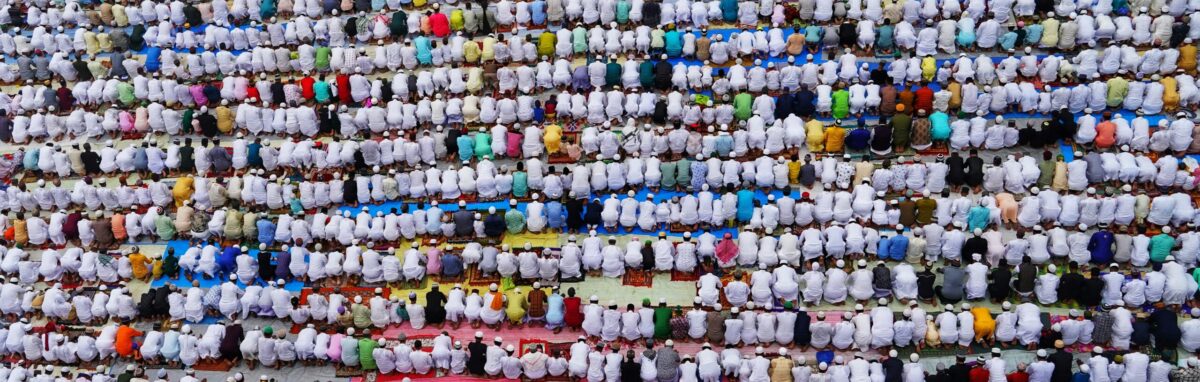
No other congregational prayer is as strongly encouraged. So even if we miss the congregation, we should make every effort to pray it individually, prioritizing it above all other activities and events.
If we expand our view beyond the legal ruling, we see Eid salah as a public act of devotion, a moment where the entire community gathers to celebrate the completion of a month of obligatory and extra acts of devotion, all of which were intended to reshape our inner state and increase us in taqwa, restraint, and patience.
In this way our tradition always holds legal rulings and spiritual meaning together.
This is why for many of the great spiritual masters, Eid symbolizes the moment when the servant “arrives” at presence and intimacy with Allah. Spiritual poetry speaks of this different kind of Eid:
عِيدِ عَاشِقَانْ بُوَدْ هَر دَم لِقَا
عِيدِ عَامَّه هَمَانْ يَكْ رُوزِ سَال
The Eid of the lovers is at every moment of meeting (the Beloved);
The Eid for most people is just one day in the year.
(Jalal al-Din Rumi, d. 672/1273)
And:
وَلِي فِي هَوَاهُ عِيدُ وَصْلٍ مُجَدَّدٌ
يَعُودُ بِهِ عِيدِي عَلَيَّ وَيُسْعِدُ
In His love I have a Eid of union, ever renewed,
My Eid returns to me by Him, and it brings me joy.
(Author unknown)
[note the play on words of Eid as a renewed and returning experience, because Eid in Arabic comes from the root ع-و-د with the meaning of return and renewal]
These meanings are integrated into the Eid celebrations of Muslim cultures. In Syria, a popular Eid nasheed still chanted on the days of Eid reminds listeners:
عيدي شهودي وعوني أنت ياعيني
والعيد عندي دوام المحوِ عن عيني
“My Eid is my witnessing [of Allah], and You are my support, O my Beloved;
And Eid, for me, is the persistence of effacement from my self [my ego].”
In this light, Eid becomes a mirror for our state: after a month of increased devotion, have we arrived at a deeper awareness of Allah? And are we increased in longing for the breaking of the fast of separation that is this life, which culminates in the Eid of the meeting with our Lord?
Moving from this spiritual contemplation to the lived experience of Eid salah, we often experience uncertainty about how it is prayed.
You might have prayed behind an Imam who does three extra takbirs in each rakʿah, another who does seven in the first and five in the second, and yet another who does six and five. It’s one of those prayers we don’t pray often and possibly not at the same place. There’s a lot of counting and a lot of people. You might think you have it right and then hear the imam and think, he may have lost count or maybe you did. Who is right? Well, everyone. That’s because the Hanafis do 3 takbirs, the Shafiis and Hanbalis do 7 and 5, and the Malikis do 6 and 5.
These different approaches go back to differences among the Prophet’s ﷺ companions and how the early Islamic legal regional traditions treated difference.
SHAFIʿI & HANBALI
7 · 5 Takbirat
Aʾisha and Ibn ʿUmar report 7 and 5 takbirs which was the basis for Shafiʿi and Hanbali opinions. These schools of thought privileged the most authentic hadith with strong chains of narrations over other sources.
MALIKI
6 · 5 Takbirat
The practice of the people of Madinah was 6 and 5 takbirat and this is the Maliki opinion. This school of thought gave priority to this continuous embodied communal practice over isolated reports.
HANAFI
3 · 3 Takbirat
Ibn Masʿud reported 3 and 3. As the most important companion-authority in Kufa, this formed the basis for the Hanafi view.
One interpretation as to why the companions have different opinions is that the Prophet ﷺ may have performed the Eid salah in multiple valid ways, and that different companions preserved different aspects of his practice.
When the Eid salah is complete, we ask ourselves, what comes next?
Holding to the Fast after Ramadan
We’ve all heard that fasting 6 days of Shawwal carries the reward of fasting the entire year. This is mentioned in the well-known hadith:
مَنْ صَامَ رَمَضَانَ ثُمَّ أَتْبَعَهُ سِتًّا مِنْ شَوَّالٍ كَانَ كَصِيَامِ الدَّهْرِ.
“Whoever fasts Ramadan and then follows it with six days of Shawwal, it is as though they fasted the entire year.” [Muslim 1164]
But the question that often comes up is: Should you fast those 6 days right after Eid or make up any missed Ramadan fasts first?
Well, like most things in the Islamic legal tradition, it depends on which madhhab tradition you follow.
At the heart of this difference is a familiar feature of our legal tradition: Differences often arise from how scholars interpret words or phrases.
In the case of Shawwal fasts, the phrase in question is: “then follows it (ثُمَّ أَتْبَعَهُ)”
Does “then follows it” mean:
- You must complete all of Ramadan (including make-ups) before doing the six days?
- Or does it refer to fasting Ramadan generally, even if you still owe some days?
Both are possible readings, which leads to two valid approaches:
Opinion 1:
Some jurists (particularly Hanbalis) say you should make up missed Ramadan fasts first, because you have not fully “completed” Ramadan otherwise. This reflects the legal principle: obligations take priority over recommended acts.
Opinion 2:
Some jurists (associated with the Hanafi, Shafiʿi, and Maliki schools) say it is permitted to fast the six days of Shawwal first, and then make up Ramadan fasts later. This reflects the legal principle: time-sensitive acts should not be missed, especially when the obligation can still be fulfilled later.
This position also recognizes that women may have up to 15 days to make up, and may have a menstrual cycle of up to 15 days, which means it would actually be impossible for them to make up all their days and fast six more in Shawwal.
The difference of opinion here reflects different ways of prioritizing between obligations and opportunities, and of interpreting the speech of the Prophet ﷺ.
Here again, the Sunna fasts of Shawwal act as a path forward bridging us from Ramadan to Shawwal with renewed intention. It is another invitation to extend the spirit of Ramadan and maintain a relationship with fasting beyond what is obligated. So these fasts become a way of saying: I am still seeking. I want to remain connected.
From Date to State
When we step back, these three moments remind us that Eid is a day of celebration and a spiritual re-orientation built into our legal tradition.
It is a reminder that our tradition is not just a set of rulings for what to do and what not to do, but is fundamentally about forming us into the kind of people Allah wants us to be: in thought, action, and character. It is about cultivating our servitude to Allah through consistent, embodied actions.
Eid shows us that:
- Differences in practice are often rooted in the practice of the companions
- Our tradition preserves multiple valid perspectives, each grounded in evidence and thoughtful ways of interpreting it
- Legal reasoning is not a distant concept, but directly shapes how we worship and practice.
Most importantly, we are reminded that the ultimate goal is not correct performance but spiritual transformation.
The night of Eid invites us not to let go too quickly.
The Eid prayer gathers us to collectively honor spiritual transitions and express gratitude in community.
The fasts of Shawwal train us to carry our practice forward.
Threaded through each of these is a lingering question:
What remains of Ramadan in us?
In the language of our spiritual tradition, Eid is not only a day, it is a constant renewal of a state of presence, of witnessing, of nearness to Allah.
And the truest measure of Eid is not how we celebrate it, but what remains within us of this state in the months that follow.
(1) You can learn more about how we engage with weak hadiths in our online course – ‘Problematic’ Hadith Explained: Navigating the Prophet’s Legacy With Confidence.